
Up to $5M*
Revolving credit line
Revolving credit secured by your receivables, with limits often 10 to 20 times higher than fintech lenders, and none of the field exams, audits, and months of underwriting a typical bank would put you through. Draw what you need, pay only for what you use, and watch your line grow as your receivables do.
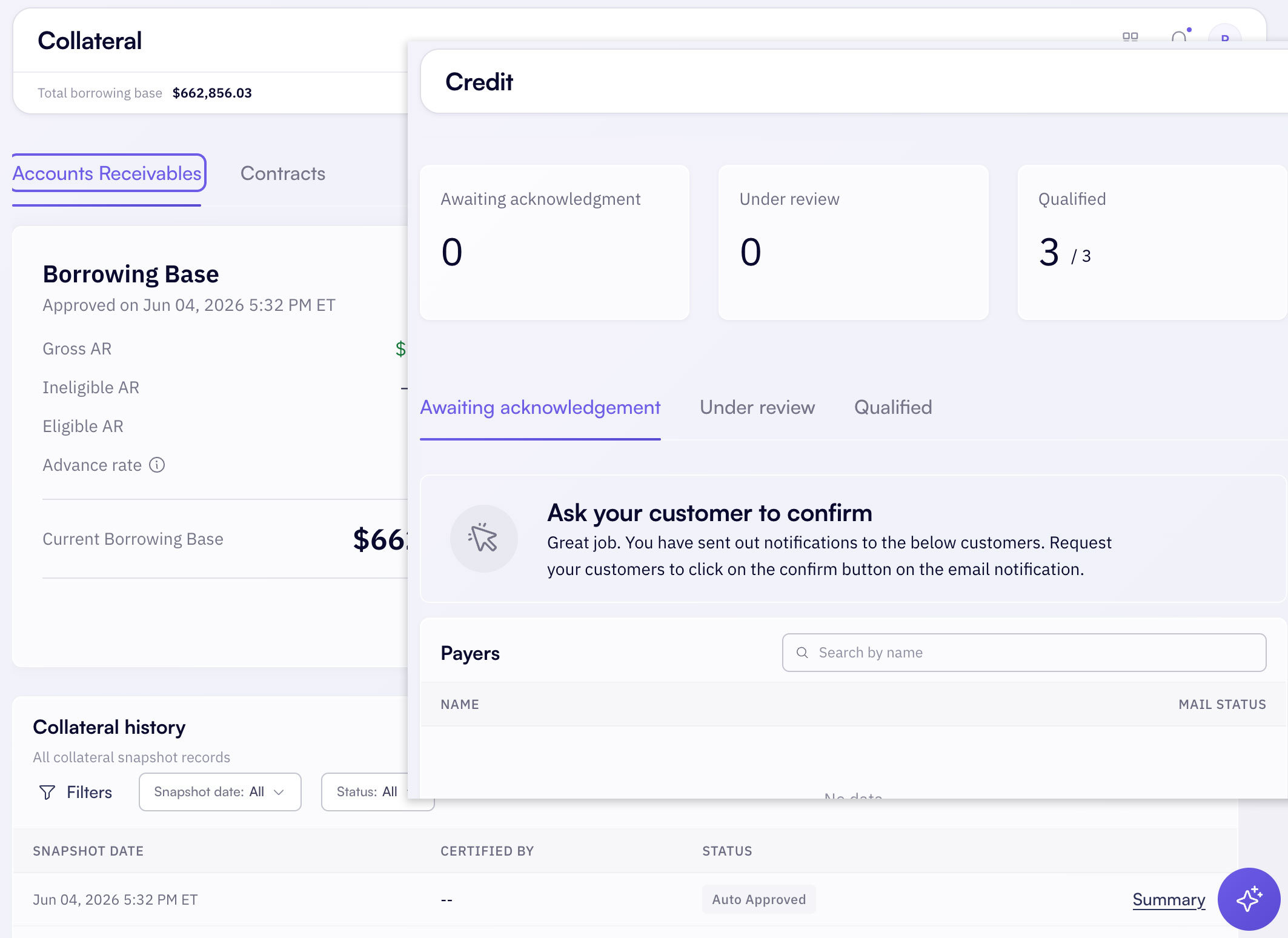




An asset-based line of credit is revolving financing secured by your business assets, most often your accounts receivable. Instead of judging you on credit history alone, the lender looks at the value of what your business is owed and extends credit against it. As those receivables grow, so does your available credit.
Because the line is revolving, it's not a one-time loan: draw what you need, repay as invoices clear, and draw again, up to your limit, paying only for what you use. That's what makes asset-based revolving credit different from a term loan or a one-time advance.
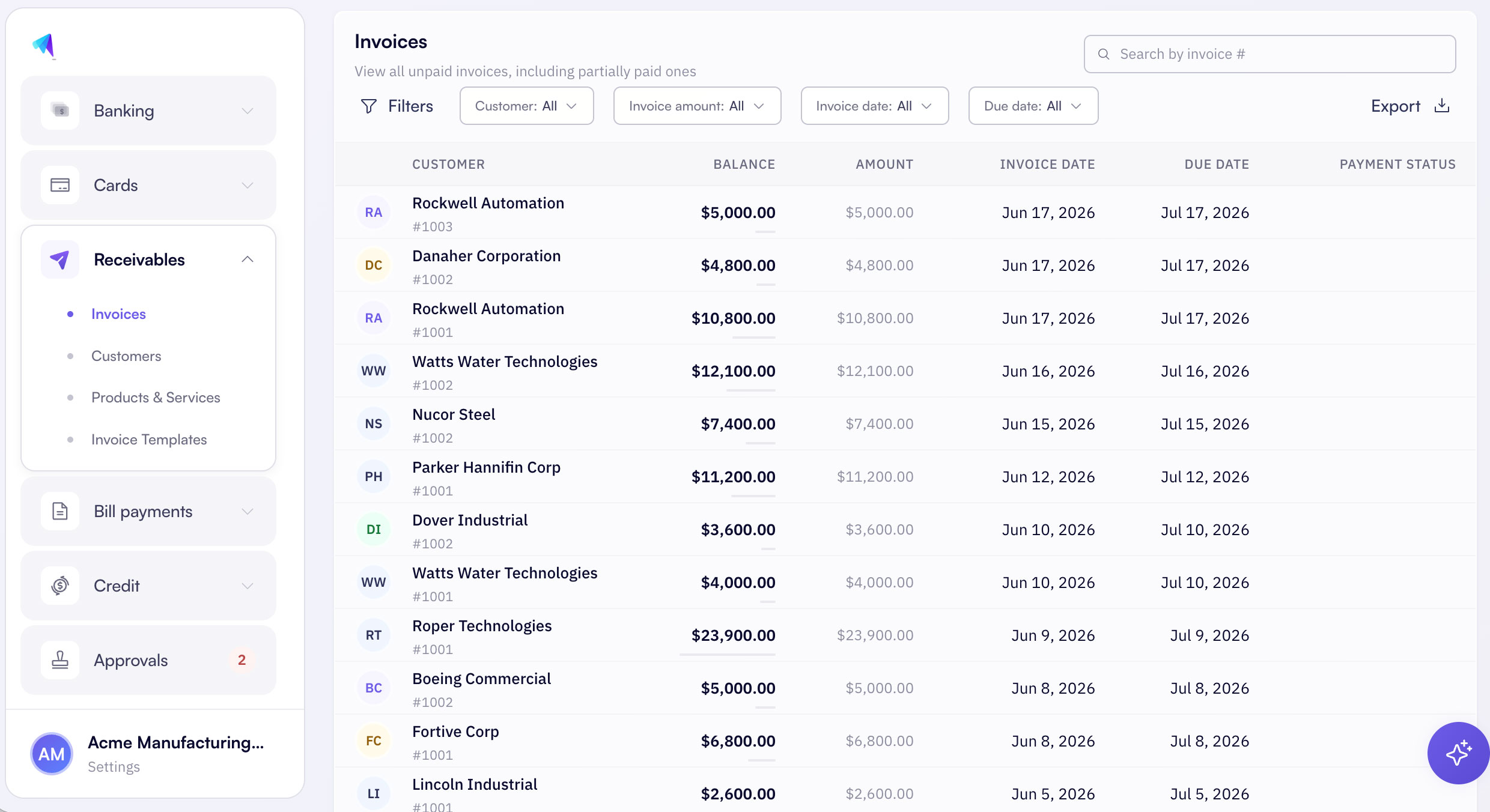
Aion's asset-based line works the way the others should. Because your receivables and banking live on one platform, Aion sees them in real time, so the weekly spreadsheets, field exams, and manual asset reports simply go away. Underwriting is faster, and your line keeps pace with your business automatically.
Most online lenders cap out around $250,000. That's fine for a brand-new business, far too little for one that's scaling. Aion is built for the next stage.
Credit sized to a real, growing operation, not a starter limit you'll outgrow in a year.
Where most online lenders stop at $250K, Aion keeps going, because the line is backed by your receivables rather than a one-size formula.
Land a bigger contract and your receivables rise; your available credit rises with them. No reapplying, no renegotiating.
If your bank said no, or offered far less than you need, it's usually not a reflection of how strong your business is. More often, it's that you don't fit a rigid formula built for a different kind of borrower. Aion underwrites on the strength of your receivables, so growing businesses get capital sized to where they're headed.
Big-bank scale, up to $5M, without the field exams, quarterly audits, and months of underwriting, and without the "here's our menu, pick one" rigidity.
A term loan hands you a lump sum you start paying interest on immediately, then makes you reapply for more. A revolving line lets you draw only what you need, when you need it, and refills as you repay.
This is capital to fund the bigger production run, the larger contract, or the next phase, without starting your financing from scratch every time.
Fast-funding options, merchant cash advances especially, usually quote a factor rate instead of an APR. A factor rate is a flat multiplier: borrow $100,000 at a 1.4 factor rate and you repay $140,000, no matter how quickly you pay it back. Unlike interest, it doesn't shrink when you repay early, which can make a merchant cash advance (MCA) far more expensive than the headline number suggests.
Aion works the opposite way. Charges accrue daily, only on the balance you've drawn, so paying down your line lowers your cost. For most clients, that's an effective cost of capital of about 2% on drawn amounts, typically cheaper than an MCA or factoring (which runs 1 to 5 percent of the full invoice), and below many traditional lines of credit.
Stated APRs range from 16% to 21% and vary with credit quality. Because charges apply only to your drawn balance and are calculated daily, the effective cost most clients pay is about 2%. And unlike a factor rate, there's no penalty for paying early.
Because the line is asset-based, qualifying is more about the strength of your receivables than a single credit score. Aion is built for established, growing businesses, roughly $1–50M in revenue.
Share a few basics about your business and see what you qualify for in minutes, with no lengthy bank process and no full application to start.
Aion verifies your receivables in real time, so underwriting is faster and more flexible than a bank's, and there's nothing to file manually.
Once approved, your funds are ready. Draw, repay, and draw again, and your line grows as your receivables do.
Up to $5M, often 10 to 20 times higher than fintech lenders, which typically cap at $250K.
The field exams, quarterly audits, months of underwriting, and manual asset reports that come with a traditional facility simply aren't part of it.
Banking, payments, and credit on one platform, so underwriting is automatic and your line stays current with your receivables.
A lending team that knows your business by name, plus AI that anticipates your needs.

"Aion is a genuine partner — not just a bank following a playbook."
Revolving financing secured by your business assets, usually your accounts receivable. The lender extends credit against the value of what your business is owed, and your available credit grows as your receivables do. You draw what you need, repay, and draw again, paying only for what you use.
Aion offers lines of $1 million, $2 million, and up to $5 million, often 10 to 20 times higher than fintech lenders that cap around $250,000. Because the line is backed by your receivables, it scales as your business grows.
A term loan is a lump sum on a fixed repayment schedule, with interest on the full amount from day one. An asset-based line of credit is revolving: you draw only what you need and pay only for what you use, and it refills as you repay.
An MCA typically charges a factor rate, a flat multiplier that doesn't shrink if you repay early, and is repaid through a share of daily sales. A line of credit charges only on what you draw, so repaying early lowers your cost. For most Aion clients the effective cost is about 2% on drawn amounts.
APR expresses cost as an annual percentage on your outstanding balance, so paying down the balance reduces what you owe. A factor rate is a fixed multiplier set at the start: borrow $100,000 at 1.4 and you repay $140,000 regardless of timing. Aion uses daily charges on drawn balances rather than a factor rate.
Often, yes. Banks decline strong businesses simply because they don't fit a rigid formula. Aion underwrites on the strength of your receivables, so growing businesses that don't fit a traditional box can still access high-limit credit.
Check your limit in minutes, connect your receivables and banking, and draw when you need it. Aion is built for established, growing businesses, roughly $1–50M in revenue, and qualifying centers on the strength of your receivables.